Leadership succession is one of the most consequential decisions a board will make, yet the preparation behind it often begins too late.
Across the Gulf, that issue is becoming more immediate. Many family businesses in Dubai established during the 1950s and 1960s anticipate a generational shift within the next five to ten years, according to Dubai Chambers cited in the Dubai Government’s 2025 family-business guidebook.
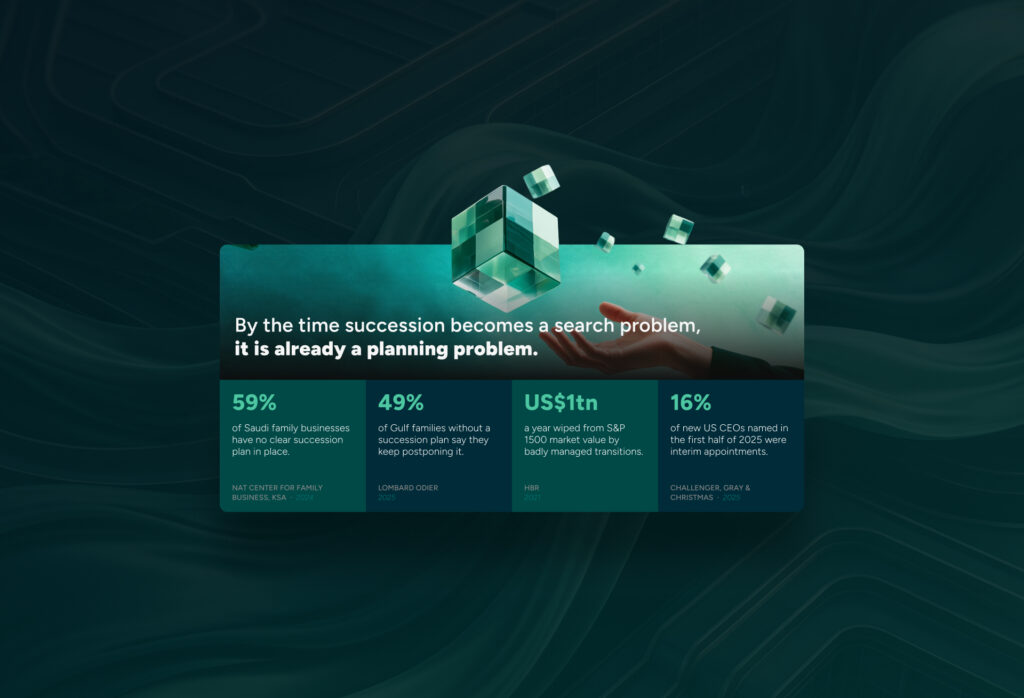
The level of preparation is less certain. Ayth Al Mubarak, CEO of Saudi Arabia’s National Center for Family Business, has said that 59% of Saudi family businesses do not have a clear succession plan. Lombard Odier’s 2025 GCC Succession Planning Survey similarly found that 49% of high-net-worth families in the region without a succession plan continue to postpone the process.
The risk is not simply an unfilled position. A poorly prepared transition can disrupt strategy, weaken stakeholder confidence and force boards into one of their most important leadership decisions under unnecessary time pressure. The cost is measurable: research published in Harvard Business Review estimates that badly managed CEO and C-suite transitions wipe close to US$1 trillion a year from the market value of S&P 1500 companies, and that better succession planning would lift company valuations and investor returns by 20% to 25%.
Succession therefore needs to be treated as a strategic process long before it becomes an executive search.
The Succession Gap Why boards need to plan before the vacancy v4
The Gap Between Intention and action
Most boards understand the importance of succession. Fewer have converted that awareness into a credible process.
The same pattern is visible internationally. Deloitte Private’s survey of 300 US family-business executives, published in February 2026, found that 85% consider strategic CEO succession planning critical to long-term success.
While 57% have a CEO succession plan in place, only 23% are actively implementing one.
A succession plan is not simply a name in an envelope. It requires a clear view of the organisation’s future leadership requirements, the strength of the internal bench and the quality of talent available externally, and enough time to assess, develop and benchmark potential successors before a search becomes urgent.
Without that groundwork, succession can quickly move from a strategic decision to a reactive recruitment exercise.
Download the full article
The rest of the piece sets out what a board can do before the vacancy: why CEO transitions arrive faster than boards expect, the two questions every board should be able to answer today, why an internal bench needs an external benchmark, and what the research says a badly managed transition costs. Complete the form below to download the PDF.