
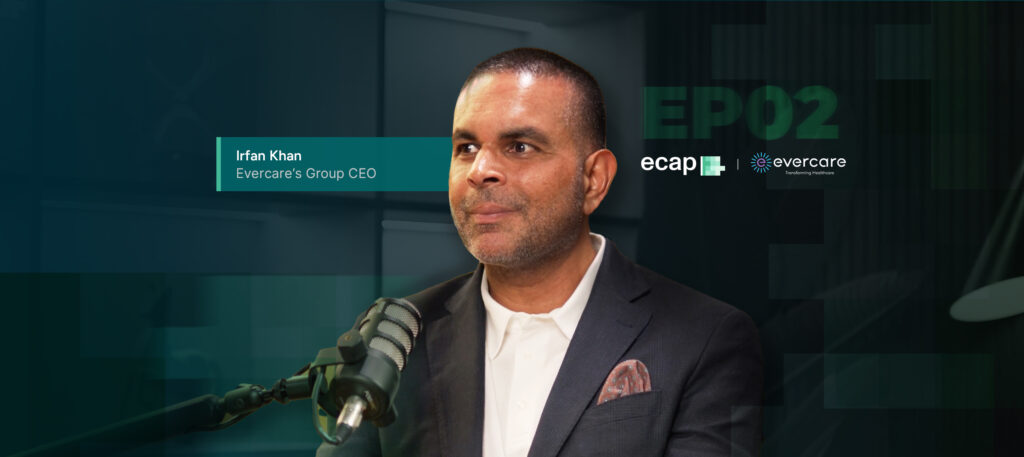

ecap Insights Podcast | Evercare × ecap Leadership Transformation Program Mini Series: Episode 2 – Beyond the C-Suite: Leadership at Every Level
In markets characterised by volatility, disruption, and rapid change, leaders must move beyond static models. In Episode 2 of ecap × Evercare, hosted by Executive Coach Maria Georgaki, Irfan Khan, Group CEO of Evercare Group, shares insights on leading through chaos, reframing uncertainty, and building resilient institutions, even in the face of systemic shocks.
“Disruption is the new normal, what matters is how you respond, not whether you will face it.”
Over the course of the conversation, Khan reveals how Evercare’s leadership development approach prepares participants not just for growth, but for turbulence.
Embracing Disruption as Default
Khan begins by establishing a vital mindset shift: disruption is not an anomaly; it is the baseline. In high-growth, frontier markets, leaders must assume uncertainty. Rather than seeking predictability, effective organisations build muscles to respond. Leadership, then, is less about planning flawlessly and more about adapting skilfully.
He shares anecdotes from Evercare’s operations across multiple countries, how supply chain shocks, political shifts, or health crises forced real-time pivots and adaptive decision making.
Resilience Through Decentralised Decision-Making
One of Khan’s core prescriptions is decentralisation. Central command can’t respond fast enough in volatile environments. Thus, he advocates for distributed leadership, giving local managers authority, tools, and accountability to respond locally. This decentralised architecture builds agility, while preserving coherence via aligned values and frameworks.
It’s a tension: enough structure to maintain consistency, yet enough autonomy to improvise.
The Role of Culture & Trust
In chaos, culture becomes the backbone. Khan emphasises investing in psychological safety, shared purpose, and trust. When leaders and their teams trust one another, they can act boldly even when data is incomplete and the stakes are high. He warns against overreliance on rigid systems; culture is what holds things together when scripts fail.
He cites how Evercare leadership coaches embed culture practices (e.g. safe spaces for failure, peer reviews, cross-hospital forums) to sustain coherence through stress.
Scenario Thinking & Fast Feedback Loops
Khan describes how Evercare embeds scenario planning in its leadership modules, not to forecast outcomes, but to stretch thinking and prepare leaders for multiple trajectories. Coupled with rapid feedback loops (pilots, sensing mechanisms, debriefs), this approach allows the organisation to test, monitor, learn, and pivot, without suffering systemic collapse.
Leaders trained this way become less tethered to a plan and more grounded in iterative learning.
Leadership Mindsets Over Methodologies
A recurring theme is that frameworks and methodologies are useful, but context often demands deviation. Khan encourages leaders to prioritise mindsets over tools; curiosity over rigid process, humility over overconfidence, and courage over complacency. This is especially true in frontier markets, where data gaps, infrastructure constraints, and emergent risk are common.
He recounts moments when “the playbook failed,” and only adaptive thinking salvaged the outcome.
When Talent Moves: Retention & Ecosystem Risk
Even in chaotic contexts, talent mobility is a constant. Khan reflects on how to retain leaders in volatile settings: through mission, growth, ownership, and trust. But he also accepts that leadership may evolve outside the organisation, and that’s not failure. The broader system strengthens as leaders carry ideas outward.
Again, Evercare’s strategy remains open: developing talent internally even if some move on.
Scaling Resilience Systematically
Khan shares that the next wave for Evercare is embedding resilience modules into the Evercare Academy curriculum. Alumni from early cohorts will train the next, reinforcing adaptive leadership norms across geographies. The goal is that each hospital, clinic, and leader develops a localised “muscle memory” for crisis navigation and innovation.
Over time, the aim is not to eliminate chaos, but to be at home in it.
Insights from the Field
Leadership coach Reem Al-Aryan (ACC) brings forward reflections from Evercare LTP alumni Tania Jalil, Eric Ochieng, and Uzair Ali Shaikh, who share how the programme has shaped their ability to lead with resilience and purpose. Their experiences reveal how the LTP’s principles translate from boardrooms into wards and regional teams, demonstrating that leadership growth at Evercare extends well beyond the C-suite.
Closing & Reflections
Episode 2 shows us that leadership is not about control; it’s about response. In complex markets, resilience, culture, and distributed trust become a leader’s most powerful tools. Evercare’s approach is not to pretend stability but to train for agility, equipping teams to act boldly when the unexpected invariably arrives.
The core implication for institutions across sectors: in uncertainty, the best investment is in leadership fit for volatility.
Listen to the full episode
🎧 Beyond the C-Suite: Building Leadership at Every Level in Healthcare
👉 Watch the full episode above or on
👉 Connect with ecap on LinkedIn
👉 Learn more https://evercaregroup.com/
Stay tuned for more episodes where we explore leadership insights across energy, healthcare, finance, and beyond.